Does METZ 65MNH7000Z fit a three-metre living-room layout?
2026-10-26
Share:
METZ 65MNH7000Z needs a 144.5 cm cabinet envelope and proper support for its 131.5 x 29.9 cm base. In a hypothetical layout, a centred viewer 300 cm away sees about 27.0 horizontal degrees; a seat offset sideways sees a different field. Furniture fit, viewing preference and mounting suitability are separate checks, so none of these numbers alone approves an installation. [S1]
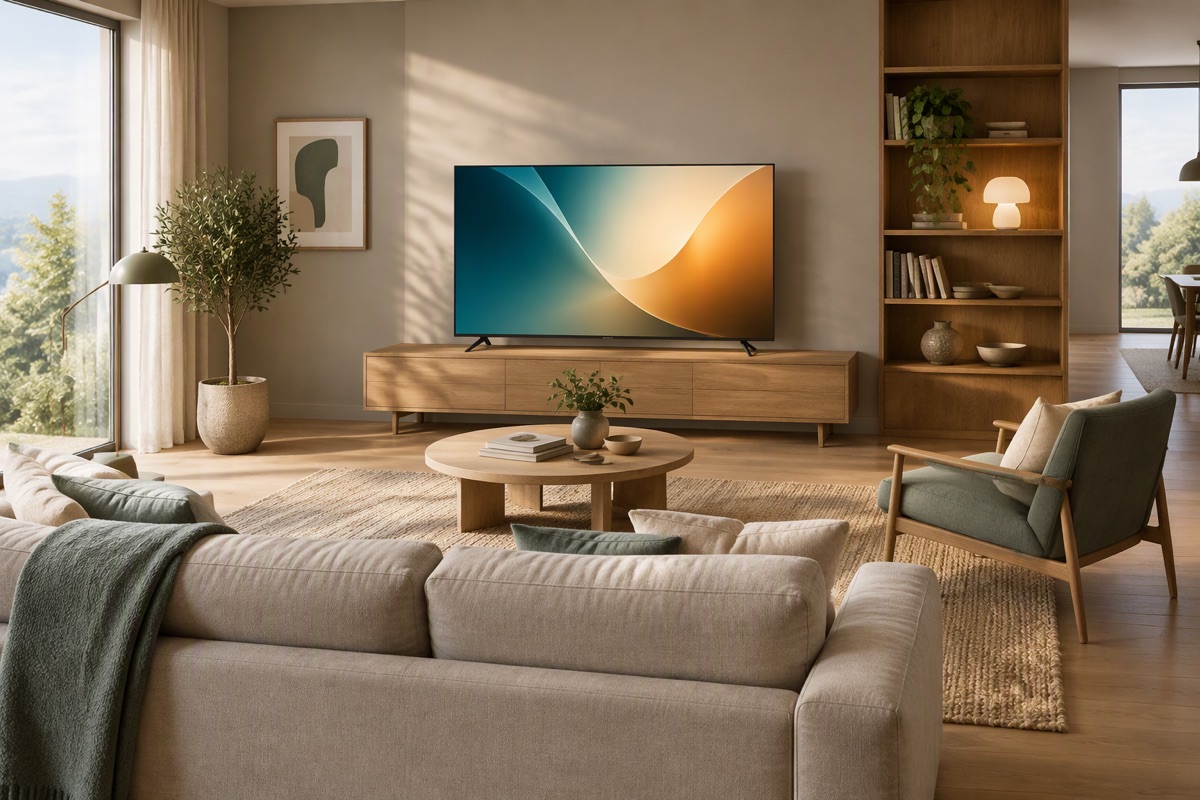
Original functional or hypothetical planning illustration. Not a product photograph, measured performance result or installation approval.
1. Which exact model do these answers describe?
These answers concern 65MNH7000Z, not an unspecified series variant. Its supplied documents list QD-MiniLED, 3840 x 2160 resolution, Google TV, WLAN/LAN, three HDMI inputs with CEC and ARC on HDMI 1, and two USB ports. Those are useful inputs for organising devices and networking, not independent evidence of picture quality. [S1]
The Italian METZ-branded series page displays 55, 60 and 65-inch choices. Ask the seller to put the full model code on the quotation, order and installation paperwork. A series choice on a website does not establish stock allocated to your address or a particular delivery service. Keeping the identity consistent prevents measurements from a neighbouring size entering the plan. [S2]
2. What exact figures belong on the installation worksheet?
Use width x depth x height order. With base, 65MNH7000Z is listed at 144.5 x 29.9 x 91.3 cm and 14.1 kg. Without base, it is 144.5 x 9.2 x 83.8 cm and 13.9 kg. Its base footprint is 131.5 x 29.9 cm. VESA is 400 x 200 mm, a transparent conversion from 40 x 20 cm in the source. [S1]
Label every configuration. A standing setup needs the complete base supported; a wall setup needs the without-base configuration and compatible attachment instructions. Neither cabinet depth nor hole spacing supplies finished wall projection, screw depth, ventilation requirements or wall strength. Those remain separate questions for the instructions and appropriate support assessment.
65MNH7000Z: facts and the questions they leave open [S1]
Fact
Documented value
Still check
Standing envelope
144.5 x 29.9 x 91.3 cm
Furniture, height and gaps
Cabinet without base
144.5 x 9.2 x 83.8 cm
Bracket projection and cable space
Base envelope
131.5 x 29.9 cm
Full support and stability
Configuration weight
14.1 / 13.9 kg with / without base
Correct support and mounting system
VESA
400 x 200 mm
Wall, screws, fixings and bracket
3. What does a 160 cm-wide support actually establish?
Assume a flat, genuinely usable 160 x 40 cm support. A centred 144.5 cm cabinet leaves 7.75 cm width difference at either side. The base envelope is 28.5 cm narrower and 10.1 cm shallower than that surface. These are hypothetical worksheet inputs and numerical differences, not specified clearances or a tested furniture recommendation. [S1]
The correct answer is conditional: investigate this standing arrangement further. Confirm furniture suitability, full base support, stability and any restraint requirements. Inspect edges and service channels that could reduce usable support. Check the instructions before allocating spare space to ornaments or a soundbar, and verify that cables do not push the television forwards.
An installation can fit yet remain awkward. Check drawers, doors, sockets and the regular walking route with the proposed position marked. If support or access fails, change furniture or investigate an assessed wall arrangement. Do not turn a positive width subtraction into permission to ignore depth, loading or daily access.
4. What changes between the central and side seats?
Assume a nominal 65-inch diagonal, a flat 16:9 image and a central viewer 300 cm from the screen plane. Calculated image width is about 143.9 cm and height about 80.9 cm, using diagonal x 2.54 multiplied by 16 or 9 and divided by sqrt(337). The documented cabinet remains 144.5 cm wide; image geometry cannot replace physical measurements. [S1]
The central image span is about 27.0 degrees, using 2 x atan(width / twice distance). For a side seat 100 cm laterally offset at the same 300 cm perpendicular distance, the distance to screen centre becomes about 316.2 cm. Its direction is about 18.4 degrees off-axis, and the two image-edge directions enclose about 24.5 degrees.
Those three quantities answer different questions: distance to centre, off-axis direction and image span. They do not describe measured METZ viewing-angle performance. A real side-seat demonstration is still needed if contrast, colour or reflections there determine your choice.
A: 0 cm offset, 300 cm perpendicular; 27.0 degrees
B: 100 cm offset, 300 cm perpendicular
B: 316.2 cm centre distance; 18.4 degrees off-axis
B image span: about 24.5 degrees, geometry only
The assumed support and two seat coordinates connect physical fit with image scale. The side seat shares the central seat's perpendicular distance but not its centre distance or angular field. No clearance, mounting or off-axis picture approval follows.
5. Is three metres a required viewing distance?
No. It is a declared input, not a recommendation for every household. At 270 cm, the same centred nominal image spans about 29.8 degrees instead of 27.0. Original calculations put assumed 30 and 40-degree fields at approximately 269 and 198 cm respectively. Try only positions compatible with the actual room and normal posture.
Sony's general guidance separates a screen-height reference minimum from mixed-viewing and cinematic examples, with personal and room-layout adjustment. It does not certify METZ or establish a medical limit. Use a removable outline to compare scale and height, then familiar content on the actual model to examine performance. An outline cannot simulate reflections or processing. [S3]
Test the regular secondary seat rather than designing exclusively for the best central position. Record a useful observation, such as preferring a lower screen or needing to move a lamp. Repeat in daytime and evening lighting before interpreting a single demonstration as representative of daily viewing.
6. What makes the complete arrangement ready to choose?
A useful decision combines suitable support, preferred image scale and a workable device plan. Reserve HDMI 1 if a compatible ARC audio connection needs it; then count the remaining source inputs. Check the intended Italian apps, account and subscriptions separately. Google TV is not a promise of every service or future app, and WLAN/LAN still needs a working home connection. [S1]
Ask for an exact-model quotation with delivery level and any setup work stated. Include necessary furniture, bracket work and cables in the budget. Stop if support, access or the mounting system remains unresolved. If the product or configuration changes, repeat the relevant checks rather than assuming another diagonal shares this model's installation details.
7. Which sources support these answers?
The supplied datasheets and checked mapping support the exact model figures; they are manufacturer-stated specifications, not independent testing. [S1] The separately fetched Italian series page supports the displayed size choices, not current address-level stock or dealer authorisation. [S2] General distance guidance supplies context, while all room inputs and image calculations here are explicitly illustrative. [S3]
Retain your own support measurements, seat coordinates, matching instructions and written delivery scope together. For wall mounting, add the actual wall and bracket assessment. Revisit that record whenever furniture or screen position changes; it is more useful than treating a hypothetical room example as a guaranteed installation.
Frequently asked questions
What are the standing dimensions and mass?
65MNH7000Z is listed at 144.5 x 29.9 x 91.3 cm, width x depth x height, and 14.1 kg with base. The base envelope is 131.5 x 29.9 cm. Support requirements remain separate. [S1]
Does a 160 cm furniture width prove compatibility?
No. Width subtraction leaves 7.75 cm at each side of a centred cabinet, but full support, depth, loading, stability, required gaps and access still need checking.
Why is the offset seat farther away?
Its assumed 100 cm lateral displacement adds to the 300 cm perpendicular distance, giving about 316.2 cm to the centre. It also changes image-edge directions; this is geometry, not measured panel behaviour.
What else is needed beyond VESA?
Use exact-model screw instructions, the 13.9 kg without-base configuration, bracket requirements and the actual wall and fixings. A 400 x 200 mm hole pattern alone cannot establish safe mounting. [S1]
Sources and scope
S1 · Supplied METZ datasheets and checked installation mapping (supplied documentation; no public web link)
Access recorded: 2026-10-16
Supports: 65MNH7000Z physical and existing configuration facts
Scope: Local: content/preflight/metz-supplied-material-recheck-20261012.json and metz-installation-preview-implementation-20261012.json; Manufacturer-stated; internal preview scope; no independent installation test
This website uses cookies to provide you with a safer and more personal experience. By accepting, you agree to the Cookie Policy and the use of cookies for advertising and analytics purposes.