QD Mini LED vs Neo QLED: direct answers on naming and evidence
2026-10-26
Share:
Neo QLED is Samsung's commercial family naming, while QD Mini LED describes quantum-dot colour with Mini LED LCD backlighting. They are not opposing physical architectures or interchangeable names for every television. This comparison pairs the naming explanation with documented METZ configuration and fit facts; it does not select a Samsung model or establish product equivalence, picture superiority or a buying winner. [S1][S2][S4][S5]
Original functional or hypothetical planning illustration. Not a product photograph, measured performance result or installation approval.
1. Does Neo QLED mean every television with QD and Mini LED?
No. The name identifies Samsung's commercial family, not every product sharing generic functional descriptions. Samsung's official launch announcement establishes its Neo QLED naming and a Mini LED light-source context. That historical source is sufficient for this naming explanation, but not for verifying every later size, generation or specification. [S5]
Functional overlap does not create synonymy. A television can have quantum-dot colour and Mini LED backlighting without belonging to Samsung's branded family. Conversely, knowing the family name does not establish identical components or behaviour across all products associated with it. Keep the difference between a category description and a commercial identity explicit.
For a shortlist, use the name to identify the material you are reading, then return to the exact candidate and requirement. Do not assume a longer or newer-sounding name delivers better pictures. Do not infer that shared generic terminology proves matching results either. Both shortcuts replace the needed evidence with vocabulary.
2. Is Neo QLED a third physical architecture?
The evidence used here does not establish a third universal architecture. Quantum dots provide a colour-conversion function: NobelPrize.org explains conversion of some blue light into red and green. Mini LED describes a backlight for an image-forming LCD, as IEEE Spectrum explains. Neo QLED belongs in a commercial-naming explanation, not alongside those functions as a newly proven physical stack. [S1][S2][S5]
A correct diagram should map words to questions. It should not invent a METZ layer order, draw a third optical construction from the Neo QLED name or make two product internals identical merely because functions overlap. Generic mechanisms are useful for understanding a listing; they are not a substitute for a teardown or engineering record.
That distinction also prevents an unfair performance claim. A shared function does not specify processing, settings, optical behaviour or accepted source modes. Without an exact comparison product and relevant evidence, the correct conclusion is that naming has been clarified, not that picture equivalence or superiority has been established.
Two naming levels, one exact-model checkpoint
Generic function: QD colour plus Mini LED illumination
Commercial naming: Samsung Neo QLED
Not interchangeable across all products
Exact-model evidence required
METZ branch: known configuration and fit
No measured cross-brand outcome
Map a generic QD Mini LED function description and Samsung Neo QLED commercial naming into separate lanes. Both lead to an exact-model evidence checkpoint. A METZ branch contains only supplied configuration and installation facts. This is not a third-architecture drawing, optical stack, competitor specification chart or performance-equivalence claim.
3. What METZ facts can I use immediately?
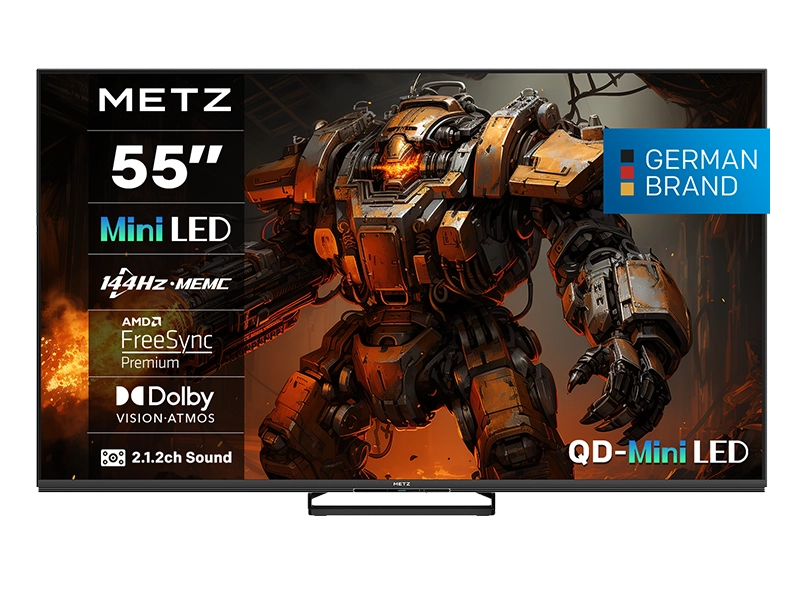
The checked records for METZ 55MNH7000Z, 60MNH7000Z and 65MNH7000Z state QD-MiniLED, 3840 x 2160, Google TV and WLAN/LAN. A household wanting that platform and a wired or wireless network option has a documented reason to investigate these candidates. These facts do not establish a match to a selected Samsung product, because no such product is evaluated here. [S4]
Each also documents three HDMI inputs, CEC on all three, ARC on HDMI1 and two USB ports. With compatible ARC audio and two HDMI video sources, reserve HDMI1 for audio and use the remaining two inputs for video. Check the equipment functions and essential Italian services before calling the whole setup suitable. A known input count is not a guarantee of every gaming or USB capability. [S4]
Keep the configuration conclusion attached to its condition. If your requirement is Google TV with that connection plan, the record is relevant. If the decisive requirement is a particular picture behaviour or unverified source mode, the same facts cannot answer it. Identifying that remaining question is more useful than assigning a brand-family score.
4. What is actually being compared here?
This is an evidence-scope comparison: documented METZ facts alongside the meaning of a commercial name. It is not a table of two tested televisions. The asymmetry matters because a naming source cannot supply a competing product's ports, dimensions or picture results just to make the columns look complete.
Direct answers with the evidence type kept visible
Question
Supported answer
What remains unknown
Next useful step
Who uses Neo QLED?
Samsung's official launch establishes commercial naming [S5]
No legal registration or current-lineup finding
Read it as a family identifier
Does QD Mini LED describe functions?
Quantum-dot colour plus Mini LED LCD backlighting [S1][S2]
Exact materials and internal arrangement
Check exact-model documentation
What METZ platform and ports are documented?
Google TV, WLAN/LAN and the stated three-HDMI layout [S4]
Every service and source-mode compatibility
Map actual household equipment
Which METZ size can fit?
Cabinet and base records allow physical filters [S4]
Full installation safety and clearances
Measure the actual space and support
Are products equivalent or is one better?
No such result established
Exact competing model and relevant tests
Seek evidence for the essential condition
Which is better value?
No current offer comparison made
Actual prices, terms and running-cost comparison
Compare real exact-model offers separately
5. How do the documented sizes change a decision?
Use a hypothetical 140 cm-wide opening. The with-base cabinets measure 122.6 x 26.4 x 78.3 cm for 55MNH7000Z, 134.5 x 29.9 x 85.8 cm for 60MNH7000Z and 144.5 x 29.9 x 91.3 cm for 65MNH7000Z, in width x depth x height order. The 65 exceeds the opening width. The 55 and 60 need further clearance, depth and support checks before installation. [S4]
A different constraint can change the feasible branch. Base footprints are 85.7 x 26.4, 116.9 x 29.9 and 131.5 x 29.9 cm respectively. A hypothetical 100 cm-wide support fails the larger two bases by width even if the surrounding opening accepts a cabinet. The smaller base remains conditional on full support, loading, depth and the full cabinet environment. [S4]
Wall mounting is another route, not an automatic fix. Documented VESA patterns are 200 x 200 mm for the 55 and 60, and 400 x 200 mm for the 65. Hole spacing does not certify the bracket, wall or fixings. These worked filters identify useful size differences without calling one television a better performer or an equivalent to another brand's product. [S4]
6. What should decide the remaining picture question?
State the condition first: natural faces, evening films, ordinary daylight programmes or your intended source workload. Then seek relevant exact-model evidence. VESA distinguishes colour coverage, accuracy and luminance conditions, illustrating why one word or headline cannot settle the whole picture. Its criteria are an evaluation framework here, not certification or measurements attributed to METZ. [S3]
For a personal demonstration, use the same source and sensible comparable settings, then judge the content that matters to your household. Record a viewing preference as a preference under those conditions, not as an independent numerical test. If essential evidence is missing, keep the conclusion open rather than using a family name to complete the answer.
The sources establish naming provenance, generic mechanisms and supplied configuration and installation facts only. Supplied refresh, brightness and HDR-list differences remain unresolved; omission is not non-support. No Samsung model, product-performance victory, METZ equivalence finding or current value ranking is introduced. A good shortlist ends with a specific next question, not a fictional winner. [S4][S5]
Frequently asked questions
Can I use Neo QLED as a generic name for all QD Mini LED?
No. It is Samsung's commercial family naming. Generic colour and backlight functions can overlap with that context without making all products part of the branded family. [S5]
Does this guide compare a specific Samsung television?
No. The Samsung source is used for naming provenance only. The concrete configuration and installation examples concern the supplied METZ models; no competitor SKU or performance result is invented.
Which METZ cabinets pass a 140 cm width-only filter?
The 55 and 60 cabinets are 122.6 and 134.5 cm wide; the 65 is 144.5 cm. The smaller two remain conditional on all required clearances, support and installation checks. [S4]
Does functional overlap prove equal picture quality?
No. It establishes shared descriptive functions, not identical components, controls or results. A performance conclusion requires relevant evidence for the exact products and conditions being compared.
Supports: Samsung Neo QLED commercial naming and historical Mini LED context only
Scope: Old research reused without fresh retrieval; not current-lineup verification; No product identifiers, promotional performance or numerical claims reused; Not independent testing or legal trademark-register verification
This website uses cookies to provide you with a safer and more personal experience. By accepting, you agree to the Cookie Policy and the use of cookies for advertising and analytics purposes.