85-inch QD MiniLED planning guide for Italy: wall-project answers
2026-10-26
Share:
An 85-inch QD MiniLED project in Italy needs three independent answers: whether the large viewing field suits the room, whether the exact product and wall system are compatible, and whether delivery reaches the agreed installation point. This research did not establish an Italian METZ 85-inch model-level match. Image geometry can guide preference now, but cannot supply cabinet, package, weight or fixing specifications.
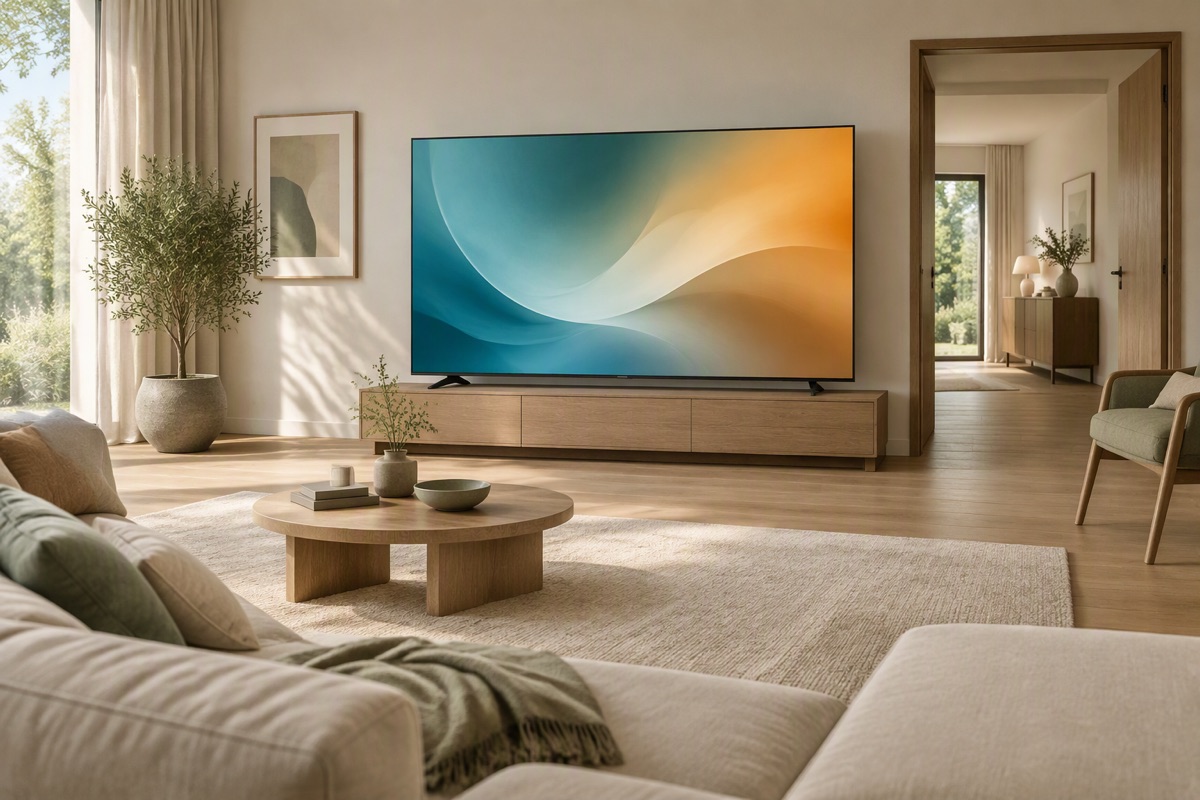
Original functional or hypothetical planning illustration. Not a product photograph, measured performance result or installation approval.
1. What must be established before selecting hardware?
Identify the full model code and obtain the applicable market document and installation instructions. Keep the household's 85-inch objective separate from that evidence gate. A category label or a similarly named foreign manual cannot alone establish the required combination of size, technology and Italian applicability. Nor can an image outline establish an offer to buy.
Next obtain exact cabinet dimensions, mass without the stand, VESA pattern and screw requirements. These determine which attachment questions can be assessed; they do not approve the wall by themselves. Hardware chosen before this information risks solving the wrong problem, especially if a later product substitution changes the attachment arrangement.
85-inch project: independent inputs and decisions
Gate
Input needed
Decision owner
Product identity
Exact code, market document, order and instructions
Seller or product contact
Attachment
Actual mass, VESA, screws and compatible bracket
Installer using exact-model evidence
Structure
Wall construction, fixings and load path
Appropriate site assessor
Room layout
Seated field, height, access and services
Household with installer
Delivery handover
Package, route, handling and agreed endpoint
Carrier and mounting team
2. What does 85-inch geometry answer?
It answers scale under declared assumptions. For a nominal 85-inch diagonal and flat 16:9 active image, original calculation gives about 188.2 cm width and 105.8 cm height. Width is diagonal x 2.54 x 16 / sqrt(337); height substitutes 9 for 16. These values describe a hypothetical image, not a measured METZ cabinet or package.
At a centred 350 cm eye-to-screen distance, horizontal span is about 30.1 degrees; at 300 cm it is about 34.8 degrees, using 2 x atan(width / twice distance). Solving for assumed 30 and 40-degree fields gives approximately 351 and 258.5 cm. The assumptions explain why the numbers differ without making one distance compulsory.
Sony's general television guidance separates screen-height reference minimums from mixed-viewing and cinematic examples, and allows room and personal adjustment. That supports a preference trial rather than a medical threshold or METZ certification. A larger angular field does not automatically improve every programme or seating arrangement. [S4]
3. How should I decide whether the field suits the room?
Begin with the normal seated posture and intended screen plane, not decorative wall symmetry. Mark a nominal image outline at the proposed height. Try the main sofa and the side chair used regularly; include subtitles and familiar content when an exact-model demonstration becomes possible. An outline evaluates scale and obstruction only, not reflections, motion or off-axis picture quality.
Compare the same image at 350 and 300 cm if the room allows both. Record what moving the seat does to doors, walking routes, lamp positions and other furniture. A closer position may deliver the wanted field while disrupting everyday access. A farther position may preserve the room's layout without changing the screen size. Neither should be called automatically superior.
For a scale reference only, a hypothetical 260 cm clear wall is 71.8 cm wider than the calculated image. That is not spare installation clearance: the cabinet, speakers, bracket and required gaps are still unknown. Keep calculated image arithmetic distinct from the actual product envelope when discussing placement.
Large-field preference and evidence comparison
Nominal 85-inch 16:9 image: 188.2 x 105.8 cm
350 cm centred trial: about 30.1 degrees
300 cm centred trial: about 34.8 degrees
Illustrative wall: 260 cm; image-only difference 71.8 cm
Seated height, side chair and daily route: check on site
Cabinet, gaps and fixing locations: exact evidence required
Two optional central distances show how the nominal image field changes. The illustrative wall-width difference concerns image scale only and does not allocate clearances or locate attachment points.
4. What makes the wall assessment a separate decision?
The structural load path depends on the actual wall, fixings and bracket arrangement as well as the product. Ask the installer to identify wall construction, structural fixing positions and any lining or void. Existing holes and decorative panels are not evidence of suitability. A nominal diagonal cannot establish load or fastening requirements.
Assess the selected bracket in its intended configuration and follow the relevant instructions. An extending arm changes projection and loading when moved away from the wall even though the screen mass is unchanged. Exact-model screw requirements also matter; a matching VESA pattern is only one compatibility input, not permission to reuse arbitrary screws or anchors.
This guide gives no universal wall rating, load multiplier, fixing list or handler count. Request a written scope identifying who supplies hardware, who assesses the complete system and what movement is allowed. Include cable routing, socket access and future service reach before work starts, rather than treating them as purely cosmetic finishing details.
5. How should delivery and installation responsibilities meet?
Obtain exact package dimensions, mass and handling instructions. The carrier should assess the continuous route through entrances, lifts, stairs, landings and turns, including headroom and obstructions. The active-image rectangle is not a carton template. A doorway measurement alone cannot settle the package's turning and handling space.
Agree the final delivery endpoint and the transfer to the mounting team. Ask where authorised unpacking and staging will occur and what access each team requires. Kerbside, threshold, floor delivery and placement near the wall are distinct services. A booking called installation may exclude difficult access, structural work or additional fixings unless the written scope includes them.
Do not improvise package orientation or unboxing to resolve a route failure. Product instructions and the team's assessed method govern handling. Keep failed-access terms, any survey requirement and completion checks together. If product or handling method changes, ask whether the assessment and appointment still apply before relying on the earlier answer.
6. What does the Italian METZ evidence establish here?
The refetched Italian METZ-branded series page displayed 55, 60 and 65-inch choices, while its launch article named 55 and 65 inches. A renewed 85-inch search did not establish a matching Italian QD-MiniLED model-level dossier or seller supply. This is an evidence boundary, not a complete range or stock census and not proof of no production. [S2][S3]
Supplied material covers 55MNH7000Z, 60MNH7000Z and 65MNH7000Z with model-specific installation entries. Their documented configuration includes QD-MiniLED, 3840 x 2160, Google TV, WLAN/LAN, three HDMI inputs with CEC and ARC on HDMI 1, and two USB ports. Those facts remain attached to those models; they do not establish an 85-inch specification. [S1]
Known smaller models are other-size choices only after a conscious change of brief. They are not equivalent answers to a fixed 85-inch goal. Ask for a larger product's matching documents instead of forcing a 65-inch substitute or using a 75-inch cross-market lead to fill the 85-inch identity gap.
7. What should remain open until the evidence arrives?
Keep product identity, seller supply, cabinet and package data, wall-system suitability and carrier handover unresolved wherever matching evidence is missing. A page's displayed sizes do not settle current delivery to your address. [S2][S3] Smaller-model records cannot supply the larger model's mass, attachment or clearance requirements. [S1]
Connect the household's scale preference with the carrier and installer's written answers before commissioning the project. Include delivery, wall work and necessary room changes in one budget. Revisit the relevant checks after any model, bracket or seating-plane change. This preserves the desired large image without converting a preference sketch into an installation approval.
Frequently asked questions
Does missing Italian evidence prove no METZ 85-inch product exists?
No. This bounded search did not establish the model-and-market match or seller supply. It cannot prove absence from manufacturing, every catalogue or every retailer's stock. [S2][S3]
Is the calculated image a mounting template?
No. The approximately 188.2 x 105.8 cm image excludes cabinet, bracket, attachment points and required gaps. Obtain exact-model instructions and a site assessment.
Can VESA alone approve an existing bracket?
No. Product mass and screw requirements, bracket configuration, actual structure and fixings must be assessed together. Hole spacing answers only one part of compatibility.
Which of the two trial seats is correct?
Neither is universally correct. The 300 cm position gives a larger nominal field than 350 cm; choose through a room-compatible preference trial rather than treating either as a medical or mandatory distance. [S4]
Sources and scope
S1 · Supplied METZ datasheets and checked installation mapping (supplied documentation; no public web link)
Access recorded: 2026-10-16
Supports: Existing 55/60/65 model configuration and installation scope
Scope: Local: content/preflight/metz-supplied-material-recheck-20261012.json and metz-installation-preview-implementation-20261012.json; No 85-inch facts or extension beyond existing 36 groups
This website uses cookies to provide you with a safer and more personal experience. By accepting, you agree to the Cookie Policy and the use of cookies for advertising and analytics purposes.