Which Mini LED TV approach fits my room, light and seating?
2026-10-24
Share:
For a reflective room, prioritise readable ordinary scenes after checking windows, lamps and shading. For wide seating, require acceptable contrast and colour from every regular seat. For evening films, compare shadows, highlights and halos together. Apply these conditions to QD and other Mini LED designs alike. METZ MNH7000Z offers documented QD-MiniLED candidates, not a verified room-performance winner.
1. State the room condition that could make a TV unsuitable
Describe the interruption rather than starting with a product label. Is a window reflected over faces during afternoon programmes? Does an angled chair lose the picture balance? Do subtitles distract during evening films? Those questions create different selection branches. A television can be a plausible candidate for one branch without having demonstrated the other, so define the conditions that are indispensable before comparing preferences.
Make a small room brief containing your usual viewing time, the main light sources and the regular seats. If both daylight and evening viewing matter, keep both rather than assuming a single demonstration covers them. This is not a furniture-dimension exercise: the central relationship is screen, light and viewer, with physical fit checked later as a supporting requirement.
A useful answer can remain conditional. It might favour a candidate only after a reflected lamp is moved, or only for the central seats actually used. State that dependency. Do not hide a failed essential condition inside an overall score merely because another part of the picture is appealing.
2. If reflections dominate, fix the geometry and assess visibility
Inspect the screen from the viewing positions at the relevant time of day. Locate reflected windows and lamps, then observe where they fall over an ordinary programme. A bright promotional landscape can conceal a problem that appears immediately on faces or darker material. The important result is whether the programme remains followable, not whether the television can display a striking highlight.
Try shading the window or redirecting a lamp when practical, then evaluate the arrangement you intend to keep. OSHA's display-environment guidance explains how excessive light and reflected sources impede visibility, and discusses shading and orientation [S2]. That supports the general check; its office context does not supply living-room illumination thresholds or a television health claim.
If a reflection remains unacceptable, require relevant visibility evidence before recommending a model for that room. Brightness and reflection behaviour are related but distinct. A short peak-output figure is not a substitute for the reflected pattern over everyday content, and QD colour conversion does not establish anti-reflection performance.
3. If viewing is shared, judge the regular seats rather than the centre alone
Check the positions people actually occupy: the central seat, the ends of a sofa and an angled chair if used. Compare faces, colour and dark detail from each. A central image can be convincing while another essential seat is not. The requirement is a usable household viewing envelope, not an excellent result averaged with a position that cannot serve its viewer.
Separate changes in reflected light from changes in the screen's own off-axis presentation. A window reflection may move as you move, while contrast or colour may also change. Observe both rather than assuming a single cause. Neither the Mini LED name nor the presence of quantum dots proves an acceptable viewing angle.
If only one central seat matters, do not invent a wide-seat requirement. If shared viewing is indispensable, do not waive it because a larger diagonal is tempting. Screen area and viewing-angle behaviour are different. A size option can match an installation brief while still needing evidence for the intended seating arrangement.
4. If evening films dominate, evaluate the complete mixed scene
Use a passage containing subtitles, a small bright object and visible shadow texture. Where local dimming is implemented, backlight illumination responds in areas rather than individually for each image pixel. Watch as text appears and disappears. Restrained halos are useful, but not an unqualified benefit if important dark texture or small highlights disappear with them.
HDR compatibility is separate from HDR presentation. A format entry does not demonstrate highlight gradation or the balance of surrounding objects. Compare relevant material in identified settings and note the compromise you can accept. If everyday movement also matters, use a normal broadcast with processing reduced and enabled rather than treating a motion label as a finished answer.
Apply the same observations to QD and other Mini LED approaches. The colour-producing arrangement cannot settle how the backlight responds to subtitles. A candidate should earn preference by its supported complete presentation, not by the number of technical words in its description.
5. Follow the condition-to-decision table
Use the table as an order of decisions. If more than one condition is essential, all must be acceptable. Optional preferences come afterwards. The aim is not to name a different untested model for every room scenario, but to identify exactly what evidence would justify a recommendation and what shortcut cannot replace it.
Room-first Mini LED choices, independent of QD status
If this describes your room
Require this result
Useful first action
Do not infer from
A window covers faces in reflection
Readable ordinary scenes in retained lighting
Check orientation and shading
QD status or a lone brightness claim
Daylight viewing is frequent
Useful visibility across relevant scenes
Compare the actual time-of-day condition
One bright demonstration clip
Several angled seats are essential
Acceptable colour and contrast from each
Inspect the regular seating positions
Larger diagonal
Subtitled evening films dominate
Retained shadows and highlights with tolerable glow
Watch transitions in the same passage
The darkest isolated frame
Colour is the final tie-breaker
Convincing skin, neutrals and textured saturation
Compare identified modes
QD as an accuracy guarantee
The installation limits the candidates
A suitable documented envelope and support plan
Check the exact model's installation facts
Technology labels as proof of fit
6. Where QD and the documented METZ options belong
QD Mini LED is one branch of the broader Mini LED choice. Quantum dots convert excitation light into other colours: the Nobel Prize account describes blue-to-red/green conversion in QLED screens [S1], and RP Photonics explains down-conversion through quantum-dot films [S3]. Non-QD arrangements use a different colour-producing approach. QD is not required by every Mini LED design and cannot guarantee the best completed picture.
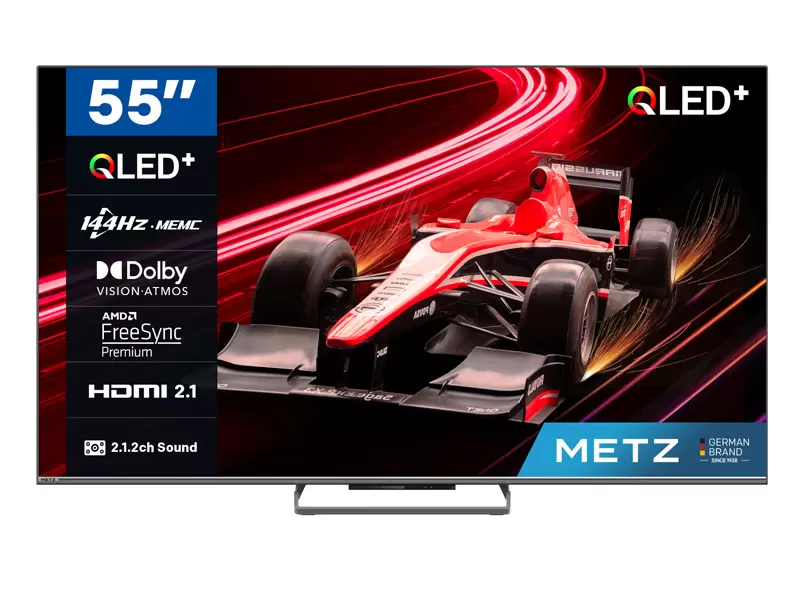
The METZ 55MNH7000Z, 60MNH7000Z and 65MNH7000Z document QD-MiniLED, 3840 x 2160, Google TV and WLAN/LAN [S4]. Those facts justify retaining a suitable version when the category, platform and network route match your needs. They do not select a daylight, wide-seat or evening-picture champion. Specific required Italian services also need a local check.
A smaller support footprint can make 55MNH7000Z the first practical candidate: its documented base is 85.7 x 26.4 cm [S4]. A wanted intermediate diagonal can point toward 60MNH7000Z; a wanted larger one toward 65MNH7000Z when the arrangement permits. Keep that supporting size decision separate from the room's light and seats. No diagonal proves stronger reflection control or a broader acceptable viewing angle.
7. Source boundary and the choice you can make now
METZ configuration and installation facts here are manufacturer-stated records, not independent room tests. Supplied performance entries exist, with unresolved refresh, brightness and HDR-list differences; this guide does not resolve them or turn an omitted entry into non-support. External sources support only the cited mechanisms and general glare guidance. No specific non-QD product, competitive winner, current price or warranty finding is supplied. Retain candidates that match the documented setup, and make a room-performance recommendation only when the deciding condition is supported for the exact version.
Frequently asked questions
Which factor should lead in a reflective room?
Start with where windows and lamps reflect from the regular seats, then assess ordinary content after practical light control. Require usable visibility in that arrangement rather than assuming a technology label solves glare.
Should a wide sofa automatically mean choosing the largest screen?
No. Screen area does not establish off-axis contrast or colour. Check every essential seating position and choose a diagonal separately from the viewing-angle assessment.
Must I choose QD to get the best Mini LED TV for my room?
No automatic rule follows. QD concerns colour conversion, while reflections, seating behaviour and backlight balance require their own evidence. Compare complete results under the same room conditions.
Which METZ is proven best for daylight here?
None is assigned that result. The documented models can be practical QD-MiniLED candidates, but a daylight recommendation needs evidence of the exact version's visibility and reflections under relevant lighting.
Sources and scope
S4 · Supplied METZ datasheets and checked installation mapping (supplied documentation; no public web link)
Access recorded: 2026-10-15
Supports: QD-MiniLED, 3840 x 2160, Google TV and WLAN/LAN for 55MNH7000Z, 60MNH7000Z and 65MNH7000Z; Documented diagonals and base footprints supporting the brief physical-fit filter
Scope: Local records: content/preflight/metz-supplied-material-recheck-20261012.json; content/preflight/metz-installation-preview-implementation-20261012.json; Datasheet locators: 55MNH7000Z pages 1/3; 60MNH7000Z pages 1/2; 65MNH7000Z pages 1/3. Manufacturer statements, not room-performance tests.; Installation additions approved for editorial previews only, not publication. No reflection, off-axis or non-QD superiority result supported; performance conflicts unresolved.
This website uses cookies to provide you with a safer and more personal experience. By accepting, you agree to the Cookie Policy and the use of cookies for advertising and analytics purposes.