QD Mini LED vs QLED: which backlight difference matters?
2026-10-26
Share:
QD Mini LED and QLED are not opposing categories: a QLED television can use Mini LED backlighting. The practical difference comes from the exact light placement, regional control and completed implementation. Compare subtitles, moving highlights and shadow detail together. METZ MNH7000Z configuration records establish a shortlist candidate, not a measured light-control advantage over an unspecified QLED product. [S1][S2][S4]
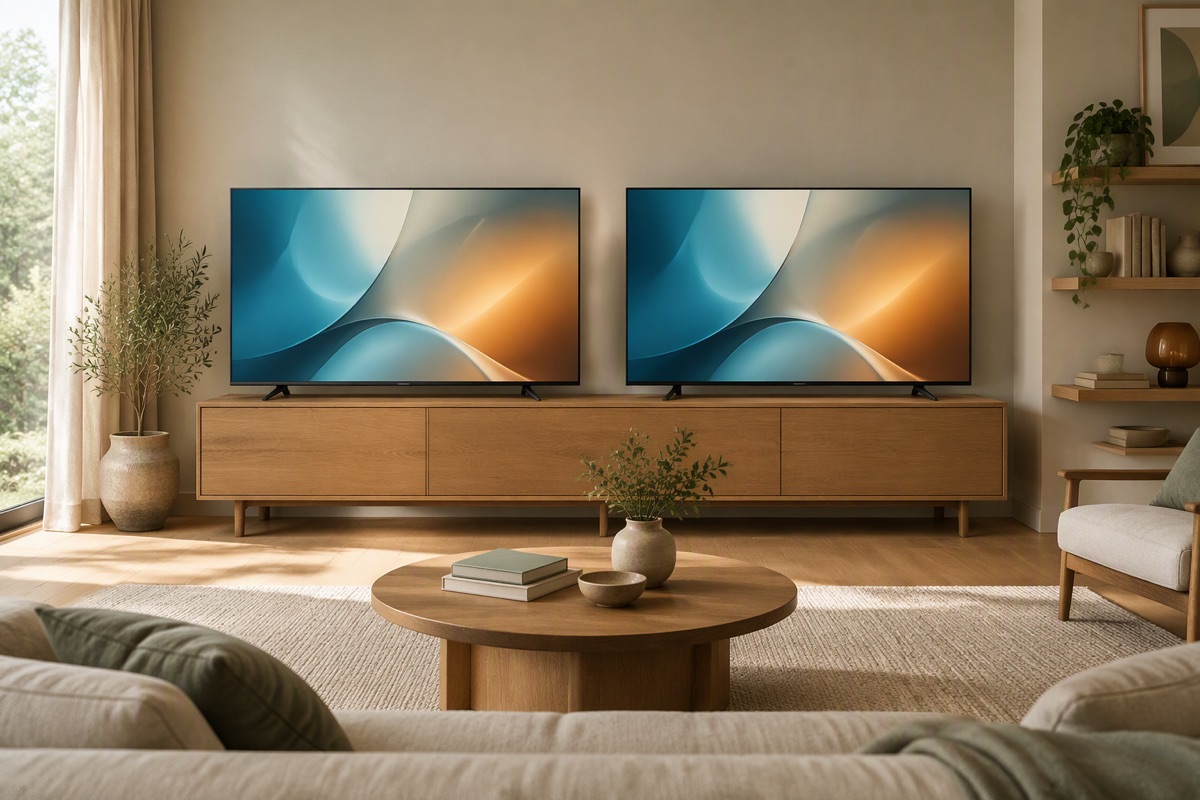
Original functional or hypothetical planning illustration. Not a product photograph, measured performance result or installation approval.
1. What actually changes between broad and regional illumination?
Broad illumination supplies light across a relatively large image area. Regional dimming can change illumination in different areas separately. When bright text shares an area with a dark face, the system must balance legible text against surrounding darkness and retained facial detail. Mini LED makes smaller sources available to the designer; it does not make an LCD self-emissive at every image pixel. [S2]
The visible differences can include a lifted background, glow around a bright object, dimmed small details or changes as an object moves. Those are possible control compromises, not findings that every product in one category behaves identically. LED size alone cannot tell you how many independently controlled regions exist, how light spreads or how the controls respond. [S2]
If evening subtitles are your main concern, the useful answer is conditional: prefer the candidate that keeps text, useful shadows and a stable background acceptable together. Do not pick the darkest background without checking whether the same setting has removed the image information you wanted to watch.
2. Does QLED tell me where the lights are?
No. In this LCD context, QLED identifies quantum-dot colour, not a single backlight placement. Edge lighting puts light sources along edges; direct lighting puts sources behind the image area. Whether and how different regions are controlled is another question. A product described only as QLED may also use Mini LED, so an abbreviated listing cannot be classified as edge-lit by default. [S1][S2]
Ask two separate questions: where is illumination supplied, and how is it controlled? A behind-screen layout does not on its own establish sophisticated local dimming. Conversely, a statement about regional control should not silently become a claim about individual pixel illumination. Exact-model documentation matters more than filling an attractive comparison chart with assumed construction.
If two candidates both document Mini LED, continue comparing their finished behaviour. Shared architecture narrows the explanation but does not settle the result. The useful distinction may then lie in optical spread, settings and control choices rather than whether one listing happens to use the word QLED more prominently. [S2]
3. Which scene answers my particular question?
Choose a scene that makes the competing demands visible. Keep source, picture mode and room lighting comparable. These are observation prompts, not simulated test results or predictions for the METZ models. Record what happens during playback rather than relying on a single photograph.
Same scene, different illumination questions
Image request: bright text plus dark texture
Placement question: edge or behind screen?
Control question: broad or regional?
Judge bright detail and shadows together
QLED may include Mini LED
Functional schematic, not measured output
Conceptual scene and control map: one subtitle-plus-shadow request leads to broad and regional illumination branches. A separate placement branch distinguishes edge sources from behind-screen sources. QLED colour is compatible with Mini LED and is not drawn as the opposing branch. No physical stack, exact zones, measured halos or METZ engineering layout is represented.
A condition-to-observation guide for backlight comparisons
Your condition
Scene to play
What could distract
What else must remain visible
Subtitles dominate film nights
Captions over a dark face and coat
Glow or background pumping as words change
Face texture and readable text
Small highlights matter
A lamp moving through a night street
A halo or changing illumination behind the lamp
Lamp detail and adjacent shadows
Faint objects disappear
A star field with varied point brightness
Tiny stars suppressed to darken the frame
Faint points as well as the background
Daylight television is the priority
Ordinary faces with the room lights present
Reflections hiding important content
Normal programme visibility, not one bright flash
The listing only says QLED
Documentation before a demonstration
An assumed edge-lit classification
The possibility that it also uses Mini LED [S1][S2]
4. How do I tell an improvement from hidden detail?
Repeat the same scene while looking at different parts of the picture. First notice the glow and dark background; then follow facial texture, fabric folds and the bright object itself. If a control reduces the glow but makes the lamp weak or the face featureless, the result is a trade-off. Your preference can be legitimate without calling the change an unqualified improvement.
Let a bright object move. A static frame does not show whether background levels change as it crosses areas or whether captions cause illumination to rise and fall. Watch from the normal seat before checking outer household seats. Keep an observation about your seating arrangement attached to those conditions rather than generalising it into a numerical viewing-angle claim.
Finally distinguish spatial control from overall light output. VESA treats small-area, brief full-screen and sustained full-screen luminance separately. A bright flash cannot alone explain ordinary daytime visibility, and good control around a small highlight cannot remove a reflected window. If the room is the problem, assess the room rather than asking the backlight label to answer everything. [S3]
5. What can the METZ records answer directly?
METZ 55MNH7000Z, 60MNH7000Z and 65MNH7000Z document QD-MiniLED, 3840 x 2160, Google TV and WLAN/LAN. Each documents three HDMI inputs with CEC on all three, ARC on HDMI1 and two USB ports. If those are your platform, network and connection requirements, the family has a concrete reason to enter your shortlist. Essential Italian services and equipment compatibility still need checking. [S4]
For compatible ARC audio plus two HDMI video sources, reserve HDMI1 for audio and allocate the other two inputs to the sources. That is a workable input-count plan, not a statement about every accepted gaming mode, bandwidth or response time. The records answer the wiring question; they do not report how subtitles look on the screen. [S4]
Installation provides a separate direct answer. Base footprints are 85.7 x 26.4 cm for the 55, 116.9 x 29.9 cm for the 60 and 131.5 x 29.9 cm for the 65. On a hypothetical 100 cm-wide support, the larger two fail a width-only check. The 55 still needs full support, suitable loading, cabinet clearance and sufficient depth. [S4]
6. What conclusion can I take into a shop or shortlist?
Take a short brief: exact candidate and backlight documentation, your hardest scene, the normal room conditions and any non-negotiable wiring or furniture limits. If configuration or installation fails, you can eliminate that candidate without claiming an inferior picture. If the physical setup works, compare the whole scene rather than awarding points to the longer technology name.
Keep colour as another question. Quantum dots convert some blue light into red and green, but do not establish accurate skin tones. VESA separates gamut and accuracy from luminance evaluation. If both televisions already use quantum dots, repeating the colour label does not explain their different dark-scene behaviour. [S1][S3]
The METZ configuration and installation statements come from checked supplied records, not an independent picture test. Refresh, brightness and HDR-list differences in supplied material remain unresolved; omission is not feature non-support. The defensible outcome is a conditional shortlist and a clearer viewing question, not a fictional universal winner. [S4]
Frequently asked questions
Can QLED and Mini LED describe the same television?
Yes. QLED concerns quantum-dot colour; Mini LED concerns LCD backlighting. A QLED-only listing leaves the exact backlight unresolved rather than proving it is edge-lit. [S1][S2]
Does a smaller LED mean one light per pixel?
No. Backlight sources, controlled regions and image pixels are different units. Smaller sources can support design choices, but their size does not establish pixel-level illumination or a finished dimming result. [S2]
Which METZ base passes a 100 cm width-only check?
The 55MNH7000Z base is 85.7 cm wide; the 60 and 65 bases are 116.9 and 131.5 cm. Only the 55 passes that particular width filter, before depth, loading, support and clearance checks. [S4]
Does less visible blooming always mean a better picture?
Not if useful stars, shadows or the bright object were also suppressed. Judge the retained content and background together under comparable conditions, especially while subtitles or highlights move.
This website uses cookies to provide you with a safer and more personal experience. By accepting, you agree to the Cookie Policy and the use of cookies for advertising and analytics purposes.