QD Mini LED vs QD-OLED: black control, motion and everyday trade-offs
2026-10-26
Share:
QD Mini LED versus QD-OLED is most useful as a comparison of light control, not another quantum-dot glossary. A backlit LCD manages light across regions and image pixels; QD-OLED controls emission at its OLED subpixels. That difference matters around subtitles, moving objects and recurring graphics, but it does not establish every television's brightness or gaming result. Start with the scene that exposes your household's main concern. [S2][S3]
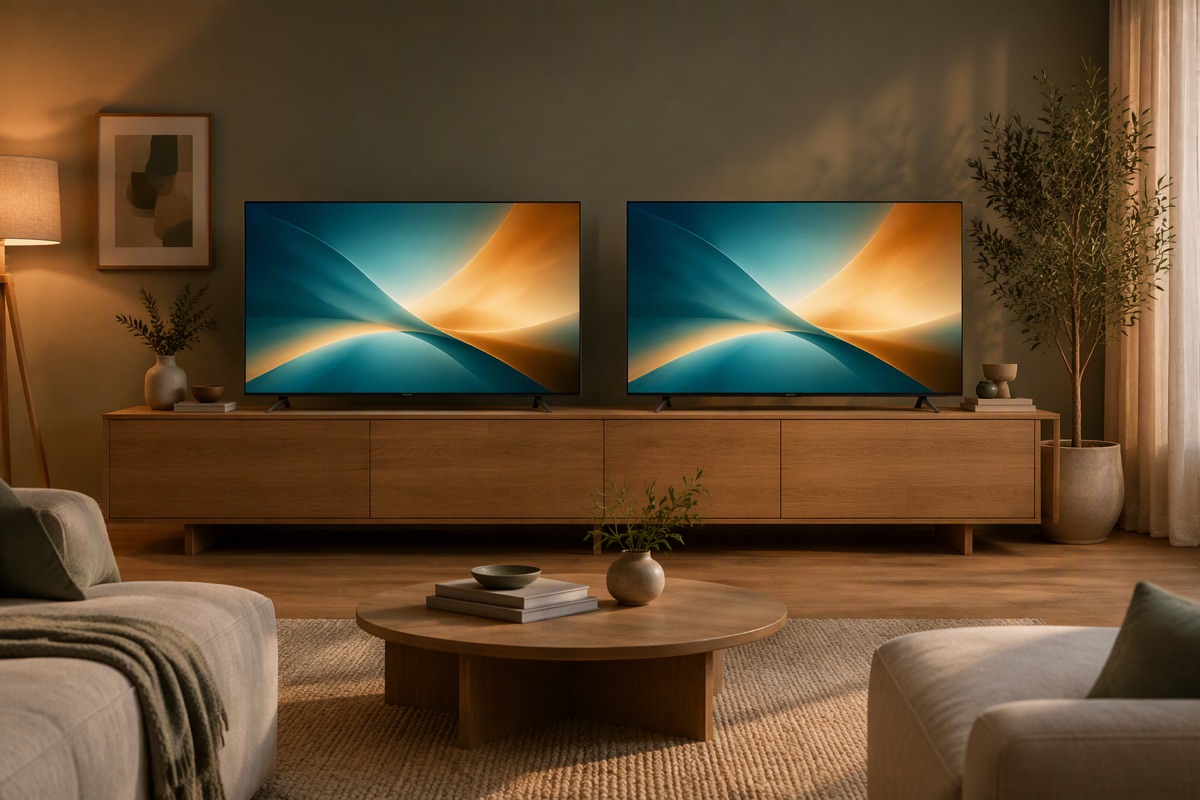
Original functional or hypothetical planning illustration. Not a product photograph, measured performance result or installation approval.
1. Compare the scale of control, not another layer list
A backlight region can serve many LCD image pixels. When one part of that region requests a bright subtitle and another requests darkness, the system must balance illumination with LCD transmission. QD-OLED instead uses blue OLED emission with red and green quantum-dot conversion: emitting subpixels can stop producing light beside illuminated neighbours. This is a functional distinction, not a drawing of either television's physical construction. [S2][S3]
The shared QD ingredient describes colour conversion, not shared black control. QD-OLED belongs within OLED; it is not the name for all OLED designs. In these implementations the quantum dots are optically excited, rather than an independently electrically driven quantum-dot image source. With that boundary established, the useful questions are what remains visible, what moves clearly and which workload the household actually creates. [S2]
Regional illumination versus emitting-subpixel control
QD Mini LED: regional backlight and LCD modulation
Bright and dark image requests can share illumination
QD-OLED: emitting OLED subpixels
Quantum dots convert colour; they do not define control granularity
Conceptual functions, not physical model construction
A backlight region supplies multiple LCD pixels requesting different outputs. QD-OLED blue OLED subpixels supply image light with red and green quantum-dot conversion. Adjacent emission can be controlled independently. This functional comparison shows relationships, not a METZ layer stack or measured dimming result.
2. Use subtitles to compare black control and retained detail
QD-OLED has a genuine architectural advantage when a small bright object sits against black: neighbouring emitting pixels can remain off. A backlit LCD may show a halo because regional illumination and LCD transmission must serve conflicting requests. Smaller backlight LEDs do not make the LCD self-emissive. The visibility of the compromise still depends on the complete implementation, scene and settings. [S3]
Try moving subtitles over a dark coat and a dimly lit face. Follow the lettering, the surrounding darkness and the coat texture together. If a setting makes the background darker by hiding the coat, it has not necessarily improved fidelity. Repeat under your normal evening light. Pixel-off black remains a real strength, but reflected room light can still affect the black you perceive.
3. Separate fast transitions from the motion you actually see
Rapid OLED pixel transitions are a genuine strength of QD-OLED. They reduce one source of transition-related smearing, but do not independently determine complete motion clarity. Sample-and-hold presentation is another part of perceived movement; a slow film pan can raise a different concern from a fast game object. Processing delay is a separate question again. Do not replace these distinctions with a single claim that either architecture is better for every moving image. [S3]
For a meaningful comparison, bring familiar material: a slow pan, a moving face and the game controls you normally use. Keep the source and picture mode attached to each observation. A subjective preference is useful without being a latency measurement. If a particular source capability is essential, confirm it for the exact television; a connector count or technology label does not verify it.
4. Test sustained scenes separately from highlights and reflections
A small bright highlight, a brief full-screen flash and a long bright scene make different demands. VESA separates those conditions, and also separates colour coverage from accuracy. Its criteria help frame questions; they do not certify a METZ model here. Quantum dots alone prove neither natural faces nor a particular luminance result. Include neutral greys and gradients rather than judging only saturated demonstration images. [S4]
In daylight, first identify whether the problem is a window reflected across the seat or general ambient light. Then compare a dark programme and a sustained bright scene from the main and regular side seats. Moving a lamp or controlling a window may change the setup more directly than changing a label. No current METZ brightness, reflection or side-angle advantage follows from the mechanism explanation.
5. Match static-content risk to a real weekly routine
Repeated bright graphics can contribute to differential ageing in OLED materials. A fixed interface used for long sessions deserves a different discussion from varied films with occasional captions. This is a workload consideration, not a prediction that every QD-OLED will burn in. Consult the exact model's care guidance and describe how often the same elements recur instead of relying on a frightening isolated anecdote. [S3]
LCD-based QD Mini LED avoids that particular OLED emissive-pixel ageing mechanism, not every possible persistence, ageing or hardware fault. Neither architecture guarantees a longer service life or lower running cost. Compare exact-size energy information on the same basis, and include necessary mounting and external equipment in a current complete quotation rather than assuming a permanent technology-wide price order.
6. Keep the METZ shortlist grounded in configuration and fit
METZ 55MNH7000Z, 60MNH7000Z and 65MNH7000Z document QD-MiniLED, 3840 x 2160, Google TV, WLAN and LAN. Each has three HDMI inputs with CEC on all three, ARC on HDMI1 and two USB ports. Those facts can match a household platform and device plan. Compatible ARC audio using HDMI1 leaves two HDMI source inputs; confirm essential Italian services for the intended setup. [S1]
With-base width x depth x height is 122.6 x 26.4 x 78.3 cm for 55MNH7000Z, 134.5 x 29.9 x 85.8 cm for 60MNH7000Z and 144.5 x 29.9 x 91.3 cm for 65MNH7000Z. Choose a workable support and size before comparing preferences. Required clearance and stability remain separate checks. If picture or gaming performance is decisive, retain the exact candidate only after relevant model evidence resolves that requirement. [S1]
7. Finish with the scene that could change your choice
Weight QD-OLED's pixel-level black control honestly when fine bright detail in darkness is your main concern. Weight its rapid transitions honestly too, without turning them into an input-latency guarantee. For recurring fixed interfaces, make care and workload explicit. For daylight, resolve the room reflection and sustained-scene question rather than importing a category-wide brightness verdict.
More than one architecture may survive those tests. A documented METZ configuration and installable size are valid shortlist reasons, not evidence of a head-to-head performance victory. The broader choosing guide can help prioritise household scenarios; the 55-inch guide handles physical layout. Manufacturer documents supply METZ specifications [S1]; the external sources explain mechanisms and evaluation conditions, not measured METZ results. [S2][S3][S4]
Frequently asked questions
Does QD-OLED really have finer black control?
Yes. Emitting pixels can stop beside bright ones, while LCD images still modulate a backlight. Compare retained shadow detail and moving subtitles as well as black backgrounds; actual room light still matters. [S2][S3]
Does faster OLED response prove lower game latency?
No. Pixel transitions, frame presentation and processing delay are different. Give OLED its genuine response strength, then confirm source compatibility and input responsiveness separately for the exact model. [S3]
Does QD Mini LED eliminate every ageing risk?
No. It avoids the OLED emissive-pixel differential-ageing mechanism, not all persistence or hardware failures. Repeated static use matters for OLED, but does not make burn-in inevitable. [S3]
What can be concluded about METZ here?
The documented configuration, source arrangement and size can fit a practical brief. The records used here do not establish a measured black, brightness, motion or reflection win over QD-OLED. [S1]
Sources and scope
S1 · Supplied METZ material recheck and checked installation mapping (supplied documentation; no public web link)
Access recorded: 2026-10-16
Supports: Shared configuration and per-size installation figures
Scope: Local: content/preflight/metz-supplied-material-recheck-20261012.json; content/preflight/metz-installation-preview-implementation-20261012.json; Manufacturer specifications; no independent performance test; historical evidence reused, no new retrieval
Supports: LCD backlighting versus blue OLED emission and red/green QD conversion
Scope: Historical mechanism context reused from existing evidence, not newly fetched; No generation performance figures, rival recommendations or METZ teardown
This website uses cookies to provide you with a safer and more personal experience. By accepting, you agree to the Cookie Policy and the use of cookies for advertising and analytics purposes.