QD Mini LED vs OLED: which strengths matter for a METZ shortlist?
2026-10-26
Share:
OLED offers genuine pixel-level black control and rapid pixel transitions. QD Mini LED uses a backlit LCD approach whose brightness and regional dimming depend on implementation. Neither label settles every household's choice. Assess METZ 55MNH7000Z, 60MNH7000Z and 65MNH7000Z through their known configuration and physical fit, then resolve essential picture or gaming questions; do not assume a win over an invented OLED comparison model.
1. What is the actual technical difference?
QD Mini LED combines an LCD image layer, quantum-dot colour technology and a Mini LED backlight. The LCD regulates supplied light; regional backlight control can support contrast where local dimming is implemented. OLED pixels generate light individually and can stop emitting for black. TFTCentral explains these mechanisms and their consequences. A technology description is not a measurement of a named television's complete performance. [S2]
Use the original diagram below as a functional explanation only. It does not specify physical layer order, optical materials, counts or proportions. The METZ QD-MiniLED configuration entry identifies the family of technology but does not supply an engineering teardown. Keeping this distinction prevents a general illustration from becoming an unsupported claim about the construction or dimming behaviour of a particular size.
Original functional paths for image light
Backlight: supplies light
LCD: regulates image light
Quantum dots: colour function, physical order unspecified
Regional dimming only where implemented
OLED: each pixel emits or stops emitting
No zone counts, layer scale or measured comparison
Draw two process lanes. In the QD Mini LED lane, connect supplied backlight to LCD light regulation and visible image, with a separate quantum-dot colour-function label. In the OLED lane, connect individual pixel emission control directly to visible image. Indicate conceptual bright and dark areas, without photorealistic simulation. This is a principle diagram, not an actual physical stack, METZ structure drawing or test output.
2. Does OLED really produce better pixel-level black?
Yes. Individually controlled emission allows a black OLED pixel to stop producing light while a neighbouring pixel stays bright. That is a real architectural advantage for small bright objects against darkness. A backlit LCD region may serve image pixels requesting different levels, creating a compromise; blooming around a bright object is one possible result. Mini LED does not turn LCD pixels into self-emissive ones. [S2]
Assess a moving sequence with subtitles, faces and textured shadows together. A darker background is not automatically better if a setting also hides detail or suppresses a small highlight. Repeat the check in lighting like your room because both screen types reflect ambient light. OLED's black mechanism remains an advantage, while perceived contrast and the rest of the image still require a complete-model comparison.
3. Is QD Mini LED automatically better for a bright room?
No. Backlit LCD designs can provide useful brightness capability, but exact output depends on model, picture area, duration and controls. VESA distinguishes small-patch, full-screen flash and sustained full-screen luminance conditions in its criteria. That is a sound reason to ask several brightness questions rather than relying on one dramatic highlight. It does not establish a METZ performance level or certification. [S3]
Reflections need their own check. A sharp window image or a broad wash of light can obscure dark content independently of the display's peak output. Sit in the regular positions and compare a dark conversation as well as a bright scene. Plan curtains or lamp changes if necessary. The METZ technology label does not prove visibility beside your particular window, and self-emission does not eliminate reflections either.
4. Does OLED's fast response settle the gaming choice?
No, although rapid OLED pixel transitions are a genuine strength. TFTCentral explains that pixel speed alone is not the complete motion experience. [S2] Input latency concerns processing delay before the displayed response, not merely changing pixel states. The intended source mode and essential synchronisation behaviour also need exact-model confirmation. A technology advantage cannot replace those compatibility and response questions.
State your console or computer and the intended output before comparing. Timing-sensitive play needs relevant input-response evidence in the actual mode. A personal session can reveal comfort and visible motion preferences, but should not be presented as a numerical latency measurement. Keep settings, source and exact size attached to any observation, rather than transferring results from another model or a generic product family.
5. Which type advantages and remaining checks matter?
Use the table to connect each mechanism to a decision. The purpose is not to count advantages and announce a winner. A dark-room film viewer may weight black control strongly; another household may care more about a compatible connection plan or repeated static interfaces. Describe the workload honestly and resolve the conditions that could actually change the purchase.
Fair technology comparison without invented product opponents
Dimension
General distinction
Exact-candidate check
Black and contrast
OLED pixels can stop emitting; LCD regional control has compromises [S2]
Subtitles, highlights and shadow textures in motion
Brightness
Backlighting offers capability, not a universal ranking [S3]
Small highlights and sustained bright scenes separately
Pixel response
OLED rapid transitions are a genuine strength [S2]
Separate motion appearance, input latency and source modes
Static graphics
OLED differential ageing is relevant; LCD avoids that specific mechanism [S2]
Actual exposure and care guidance; no lifespan guarantee
Colour and HDR
Gamut, accuracy, black detail and luminance are distinct [S3]
Skin tones, gradients and useful highlight detail together
Shared seats
Complete panel and optical design affect the side view
Assess every regular seat on the intended size
Energy and price
Neither label determines complete running or purchase costs
Exact-size SDR/HDR energy labels and current total quotations
6. How should I treat static content, colour and cost?
Repeated static elements can cause differential ageing in OLED emissive materials under some usage conditions. That is not a prediction that every household will experience burn-in. LCD-based QD Mini LED avoids the same emissive-pixel mechanism, not every possible persistence, ageing or electronics problem. TFTCentral supports the underlying distinction, but its historical lifespan and product examples should not become current guarantees. [S2]
Quantum-dot colour capability is not proof of accurate colour. Compare natural tones and gradients in an appropriate mode, and seek relevant evidence for demanding HDR use. VESA separates colour coverage from accuracy. [S3] For running costs, compare exact-size SDR and HDR energy-label figures on the same basis. For purchase cost, include necessary support and installation work; a technology label does not establish price order or value.
7. How do known METZ facts change my choice?
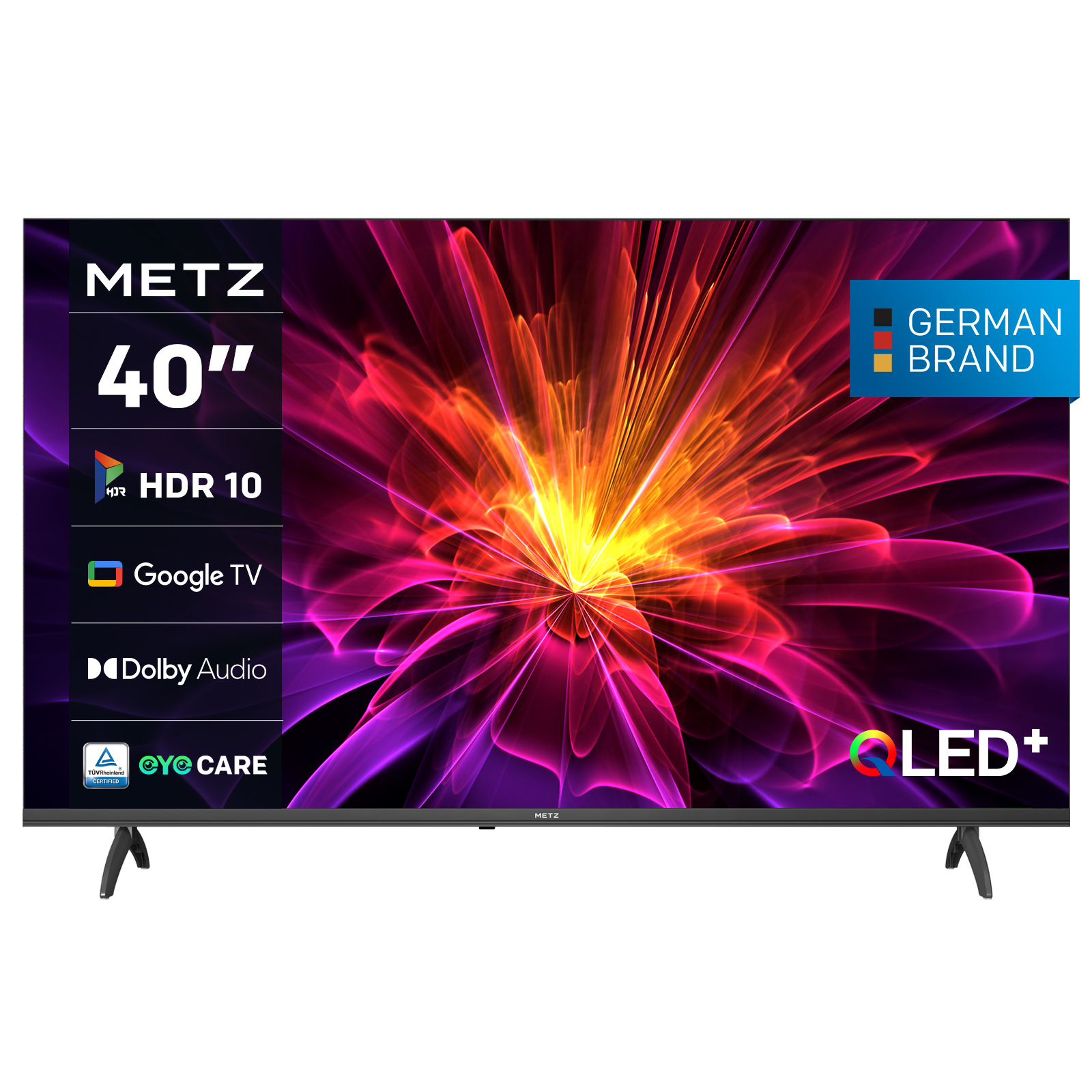
All three METZ models document QD-MiniLED, 3840 x 2160, Google TV and WiFi-WLAN/LAN. Those facts support a shortlist when this configuration matches your household. Confirm essential Italian-market services. Three HDMI inputs, with CEC on all three and ARC on HDMI1, help map sources: compatible ARC audio occupies one input, leaving two for video. This connection fit is useful without proving game modes or latency.
The physical differences can eliminate a size before picture comparison. With-base dimensions, width x depth x height in centimetres, are 122.6 x 26.4 x 78.3 for 55MNH7000Z, 134.5 x 29.9 x 85.8 for 60MNH7000Z and 144.5 x 29.9 x 91.3 for 65MNH7000Z. Their base footprints are 85.7 x 26.4, 116.9 x 29.9 and 131.5 x 29.9 cm. Check complete support and required clearances separately.
A 130 cm opening excludes the 60 and 65-inch cabinets, while the 55-inch cabinet leaves 7.4 cm total before clearances. That makes only the smaller one worth further installation checking there. For wall mounting, VESA is 200 x 200 mm on the 55/60-inch models and 400 x 200 mm on the 65-inch model. Verify bracket, wall and fixings rather than treating hole spacing as a safety decision.
8. What is the responsible final comparison?
Give OLED's black control and pixel-response strengths real weight if they answer your priorities. Retain an exact METZ size when its configuration and installation fit, then resolve the remaining dark-scene, daylight or source-mode condition. Checked supplied records support METZ facts. [S1] External sources support mechanisms and evaluation only. [S2][S3] No named OLED opponent, METZ performance win, measured lifespan, price or warranty outcome is asserted. Decide from the conditions important to your room rather than a category slogan.
Frequently asked questions
What is OLED's clearest genuine advantage?
Individual emission control lets black pixels stop emitting, giving precise bright-dark separation. Rapid pixel transitions are another real strength. Neither establishes every other aspect of a complete television, and room reflections still affect what you see.
Does QD Mini LED guarantee higher brightness or longer life?
No. Brightness depends on model, scene area and duration. Avoiding OLED's emissive-pixel ageing mechanism does not prove a universally longer life or immunity to other faults. Compare exact-model evidence and the actual workload.
What do the METZ dimensions establish?
They establish practical installation differences among the three named models. For example, a 130 cm opening excludes the two wider cabinets. The smaller candidate still needs clearance and support checks; size does not create a picture-quality hierarchy.
Can this comparison prove METZ beats OLED?
No. It explains general technology strengths and the known METZ configuration and fit. A performance ranking would require relevant exact-model comparisons under known conditions. No imaginary OLED opponent or transferred test result is used here.
Sources and scope
S1 · Supplied METZ datasheets and checked installation mapping (supplied documentation; no public web link)
Access recorded: 2026-10-15
Supports: Shared configuration, HDMI layout, per-size cabinet/base dimensions and VESA
Scope: Local records: content/preflight/metz-supplied-material-recheck-20261012.json and content/preflight/metz-installation-preview-implementation-20261012.json; Specifications only; no measured comparison with OLED
Supports: OLED individual emission and fast transitions; LCD regional dimming and blooming mechanism; Differential-ageing risk with repeated static exposure
Scope: Historical monitor-focused source; numerical product and lifespan claims not reused; General principles only, not METZ model tests; No competitor artwork or promotion transferred
Supports: Separate luminance-area and duration tests; Distinct black, colour coverage, accuracy and subtitle checks
Scope: Criteria are not METZ measurements or certification; No tier thresholds attributed to METZ; Does not establish reflections, price, lifespan or input latency
This website uses cookies to provide you with a safer and more personal experience. By accepting, you agree to the Cookie Policy and the use of cookies for advertising and analytics purposes.