QD Mini LED vs Neo QLED: compare a technology description with a brand name
2026-10-26
Share:
A search for QD Mini LED versus Neo QLED mixes two kinds of description. QD Mini LED names colour and backlight functions; Neo QLED is Samsung's commercial family naming. The name is not a third physical architecture, and it is not interchangeable with every QD Mini LED television. The useful comparison here is documented METZ configuration alongside a naming explanation—not a test between two selected products or a claim that either brand wins. [S1][S2][S4][S5]
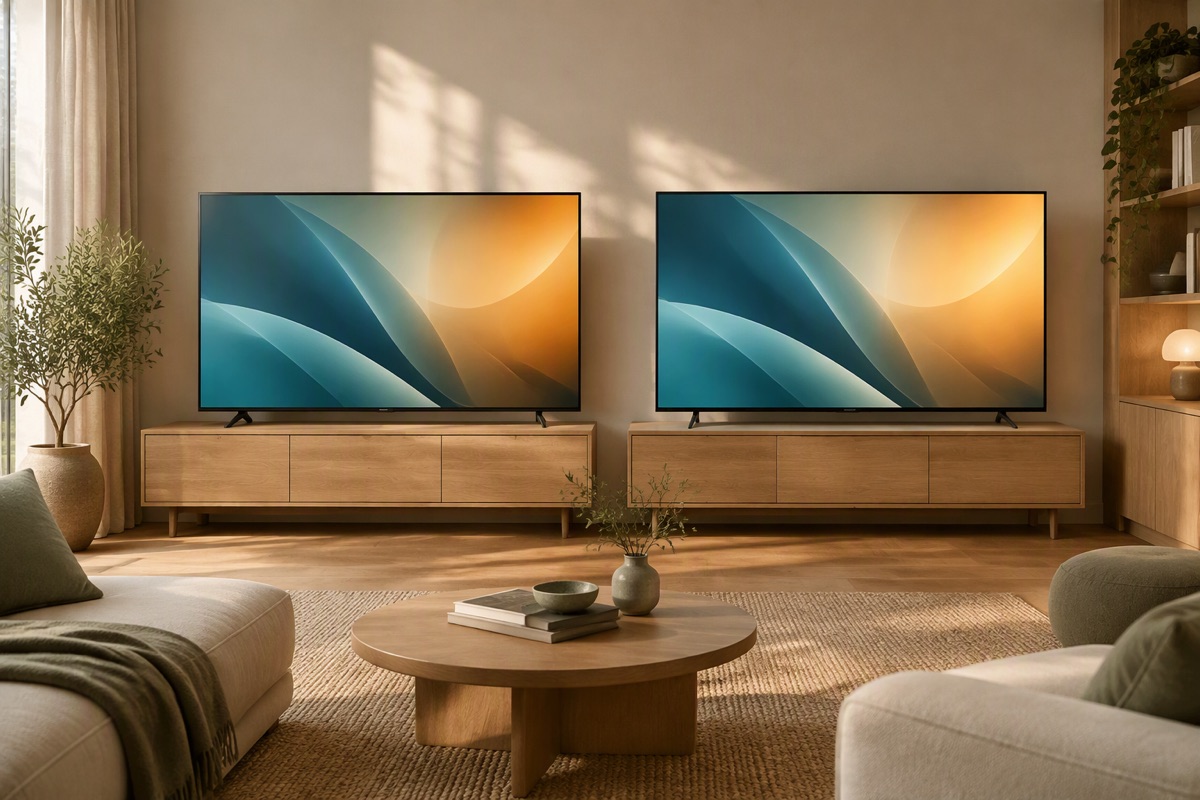
Original functional or hypothetical planning illustration. Not a product photograph, measured performance result or installation approval.
1. Decode the search result before comparing products
Imagine two browser results: one lists a METZ MNH7000Z configuration, while another prominently says Neo QLED. It is tempting to treat the second phrase as a more advanced technical category. Samsung's official launch announcement establishes that Neo QLED is its branded family naming and describes a Mini LED light source. That tells you where the name belongs; it does not provide a current exact-model performance comparison. [S5]
A generic functional description and a branded family name have different scope. QD Mini LED can describe colour conversion plus Mini LED backlighting across products using that combination. Neo QLED identifies Samsung's commercial family. Some functional vocabulary can overlap without making the branded term a generic synonym or making every member of the generic category part of that brand family. [S1][S2][S5]
The practical translation is simple: use a family name to identify what you are reading, then look for the exact television and its documented facts. Do not promote the name into a picture score, but do not dismiss it as proof of an empty product either. Naming provenance and performance evidence answer different questions.
2. Map the words to functions without inventing a third stack
Quantum dots perform colour conversion: NobelPrize.org explains that some blue light is transformed into red and green in QLED screens. Mini LED describes illumination for an LCD; IEEE Spectrum distinguishes that backlight from the LCD forming the picture. These explanations give you functional questions independent of brand vocabulary. Neither source inspects the METZ models' internal construction. [S1][S2]
Neo QLED should therefore sit in a naming lane beside the functional description, not in a third physical-stack column. A diagram with three distinct optical architectures would suggest a difference that the naming source does not establish. Equally, drawing identical internals for two families would overstate what shared functional words can prove.
The same restraint applies to generations and sizes. A historical launch explains the origin and context of commercial naming; it does not verify every later product or variant. This guide does not select a Samsung model, copy its specification table or infer that any METZ size is its technical equivalent. [S5]
Commercial naming mapped to functional questions
Generic description: QD colour plus Mini LED backlight
Commercial family: Samsung Neo QLED
Overlap of functions is not synonymy
Exact-model evidence checkpoint
METZ: supplied configuration and installation facts
No product-performance winner
Place QD Mini LED in a generic-function lane and Neo QLED in a Samsung commercial-name lane. Connect both to an exact-model evidence checkpoint, not to competing physical stacks. Place the supplied METZ configuration only on its documented candidate branch. No third architecture, identical internals, competitor product data or measured equivalence is implied.
3. Read an evidence comparison rather than a product league
The following is deliberately asymmetric: one side contains supplied METZ configuration facts; the other explains what a commercial name can establish. It is not a side-by-side product specification test. A blank performance comparison should remain unanswered rather than being filled with a presumed competitor or invented result.
Documented METZ candidate facts versus the scope of a commercial name
4. Work through a household's actual configuration question
Suppose a household wants Google TV, the option of a wired network, compatible ARC audio and two HDMI video sources. METZ 55MNH7000Z, 60MNH7000Z and 65MNH7000Z document Google TV, WLAN/LAN, 3840 x 2160 and QD-MiniLED. These facts make the family relevant to that brief without borrowing the Neo QLED name or asserting matching picture performance. Essential Italian service availability should still be checked for the intended use. [S4]
The three-HDMI arrangement gives a concrete plan: reserve HDMI1 for compatible ARC audio and allocate the two remaining inputs to video sources. CEC is documented on all three, and each model lists two USB ports. This answers input-count and placement questions. It does not establish every signal mode, USB function or gaming response. [S4]
If the household instead needs an unverified service or particular source mode, the known configuration is not enough to settle the purchase. Keep that requirement open. This is more useful than saying a commercial family is better or worse in the abstract: it identifies the precise fact that would change the shortlist.
5. Use exact METZ dimensions for a real selection difference
Consider a hypothetical 140 cm-wide opening. With-base cabinets measure 122.6 x 26.4 x 78.3 cm for 55MNH7000Z, 134.5 x 29.9 x 85.8 cm for 60MNH7000Z and 144.5 x 29.9 x 91.3 cm for 65MNH7000Z, in width x depth x height order. The 65 fails by width; the others remain candidates only after clearances and support checks. [S4]
Base footprints give another filter: 85.7 x 26.4, 116.9 x 29.9 and 131.5 x 29.9 cm respectively. An opening wide enough for a cabinet does not guarantee that the support underneath is deep, strong or wide enough for its base. Keep the support measurement separate from the cabinet measurement. Neither measurement says which picture has better colour or contrast. [S4]
For wall mounting, documented VESA patterns are 200 x 200 mm for the 55 and 60 models, and 400 x 200 mm for the 65. These are hole spacings, not bracket load ratings or wall-safety approval. Verify the wall, bracket, fixings and clearances separately. A commercial name cannot replace those exact installation checks. [S4]
6. Ask the next picture question without manufacturing an answer
Once a configuration is feasible, specify the picture condition that matters: faithful faces, dark-film subtitles, ordinary daylight programmes or a particular source workload. VESA separates gamut, accuracy and luminance conditions; its framework explains why one ingredient or headline cannot answer every requirement. It does not assign a certification or performance tier to METZ here. [S3]
The available sources establish general functions, naming provenance and supplied configuration facts. They do not establish a cross-brand picture match. Supplied refresh, brightness and HDR-list differences remain unresolved, and omission is not non-support. Retain a physically suitable METZ candidate for the needs its known facts answer, then request relevant exact-model evidence for anything essential still open. [S4]
Frequently asked questions
Is Neo QLED another name for every QD Mini LED TV?
No. Neo QLED is Samsung's commercial family naming. Generic functional descriptions may overlap with its context without making all QD Mini LED televisions part of that branded family. [S5]
Is it a third physical display architecture?
Not on the evidence used here. The official naming announcement describes a Mini LED context; the name itself does not establish a new universal image-forming principle. [S5]
Does this comparison identify a METZ or Samsung winner?
No. It compares documented METZ configuration with the meaning and limits of a commercial name. No exact competing model, independent performance dataset or model-equivalence result is supplied.
Which METZ size fails a 140 cm opening by width?
The 65MNH7000Z cabinet is 144.5 cm wide. The 55 and 60 cabinets are narrower, but required clearance, support and safe installation still need checking. This is a width filter, not a picture ranking. [S4]
Supports: Samsung commercial family naming and historical Mini LED launch context only
Scope: Prior research reused, not newly fetched or current lineup verification; No product identifiers, promotional performance claims, numerical results or artwork reused; Not independent testing or legal trademark-register verification
This website uses cookies to provide you with a safer and more personal experience. By accepting, you agree to the Cookie Policy and the use of cookies for advertising and analytics purposes.