65 inch QD Mini LED TV: a living-room plan for METZ 65MNH7000Z
2026-10-26
Share:
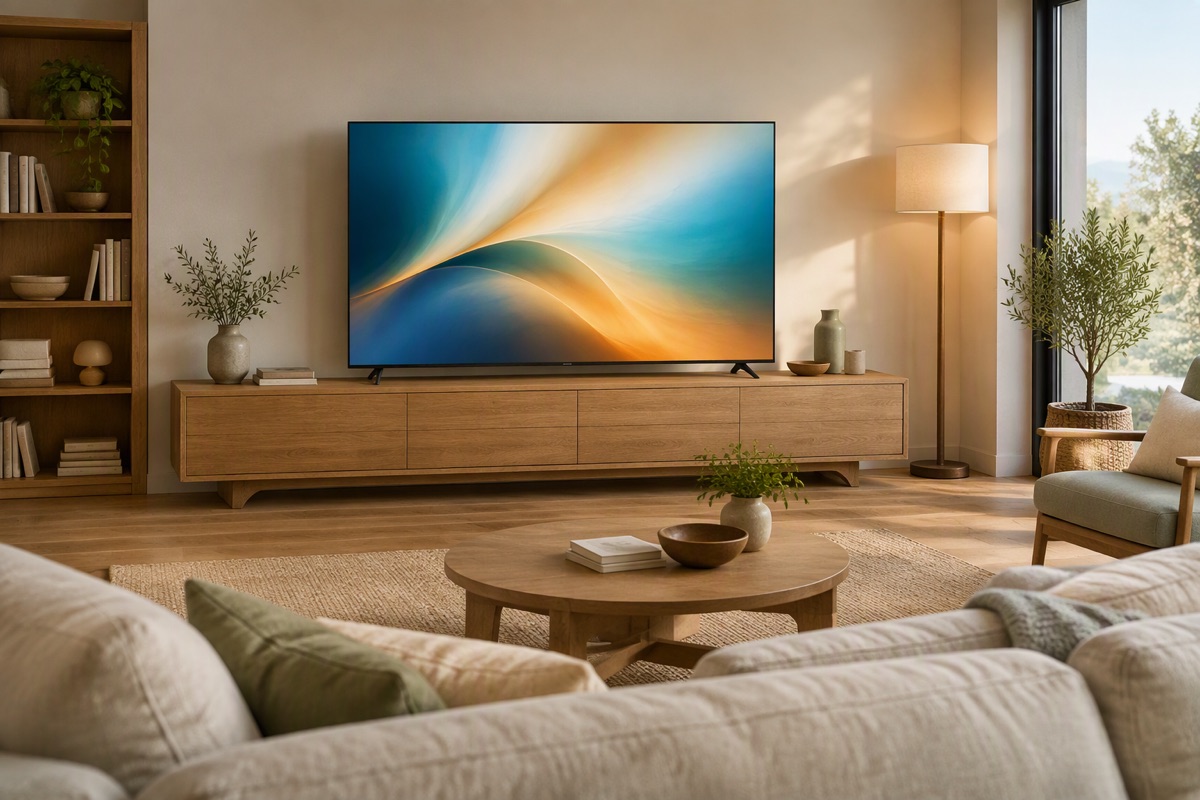
Picture an ordinary evening: one person sits opposite the television, another takes the side chair, and someone needs to walk past the furniture. A 65 inch QD Mini LED TV should work for all three activities. This worked METZ 65MNH7000Z plan starts with exact installation figures, then compares furniture fit, image scale and seating without treating a paper outline as a picture-quality test. [S1]
Original functional or hypothetical planning illustration. Not a product photograph, measured performance result or installation approval.
1. Measure the living room you actually use
Start with the intended screen plane, not the back wall. Measure from the viewer's eyes in a normal seated posture to that plane. A room described as four metres long loses usable viewing distance to furniture, the sofa and walking space. Mark the main seat, the side chair and the route between the doorway and the rest of the room.
Measure usable furniture width and depth, allowing for edges and channels. Check doors, sockets and cable bends. These checks distinguish rectangle fit from everyday convenience.
2. Keep the exact model and configuration together
The supplied 65MNH7000Z figures use width x depth x height. With base, the set is listed at 144.5 x 29.9 x 91.3 cm and 14.1 kg. Without base, it is 144.5 x 9.2 x 83.8 cm and 13.9 kg. The base footprint is 131.5 x 29.9 cm; the VESA pattern is 400 x 200 mm, converted from the source's 40 x 20 cm entry. [S1]
A base footprint is an envelope, not permission to use a shelf of exactly that size. Cabinet depth without the base is not finished wall projection. VESA describes hole spacing rather than wall strength, screw depth or complete bracket compatibility. Keep the relevant model instructions and support assessment alongside the numbers.
Assume a genuinely usable 160 x 40 cm support, a clear wall behind it and a central seat 300 cm from the intended screen plane. These are hypothetical planning inputs, not a surveyed customer installation. Centring the 144.5 cm cabinet leaves 15.5 cm total width difference, or 7.75 cm at each side. The base envelope leaves 28.5 cm total width and 10.1 cm total depth difference. [S1]
Those differences are arithmetic, not specified safety clearances. Check that the complete base is supported and that the furniture is suitable for the standing configuration. Confirm stability, any restraint requirements, ventilation and cable access using the applicable instructions. A soundbar needs its own position and must not obscure the screen or controls.
If the support fails, compare suitable furniture with an assessed wall installation. Do not solve a depth problem by allowing unsupported feet or pushing cables sharply against the wall. Keep the door and walking route on the same plan; their continued use is part of whether this example works.
4. Compare central and side seating at three metres
For an explicit scale experiment, assume a nominal 65-inch diagonal and a flat 16:9 active image. Original geometry gives approximately 143.9 cm image width and 80.9 cm height. These are calculated image dimensions; the documented cabinet width remains 144.5 cm. At a centred 300 cm eye-to-screen distance, the image spans about 27.0 horizontal degrees. [S1]
Now place a side seat 100 cm sideways from that central seat while keeping the same 300 cm perpendicular screen distance. Its eye-to-screen-centre distance is about 316.2 cm and its off-axis direction about 18.4 degrees. The image spans about 24.5 degrees horizontally there, calculated from the directions to its two edges. This is geometry, not a measured METZ viewing-angle result.
The causal difference matters: the side seat is farther from the centre and sees an asymmetric field even though it shares the same distance from the screen plane. Try both seats before changing furniture. A diagram or outline cannot tell you how contrast, colour or reflections behave from that offset position.
Centred cabinet: 7.75 cm furniture-width difference each side
Nominal image: 143.9 x 80.9 cm, calculated
Seat A: centred, 300 cm; about 27.0 degrees
Seat B: 100 cm lateral offset, 300 cm perpendicular
Seat B: 316.2 cm to centre; 18.4 degrees off-axis; 24.5 degrees image span
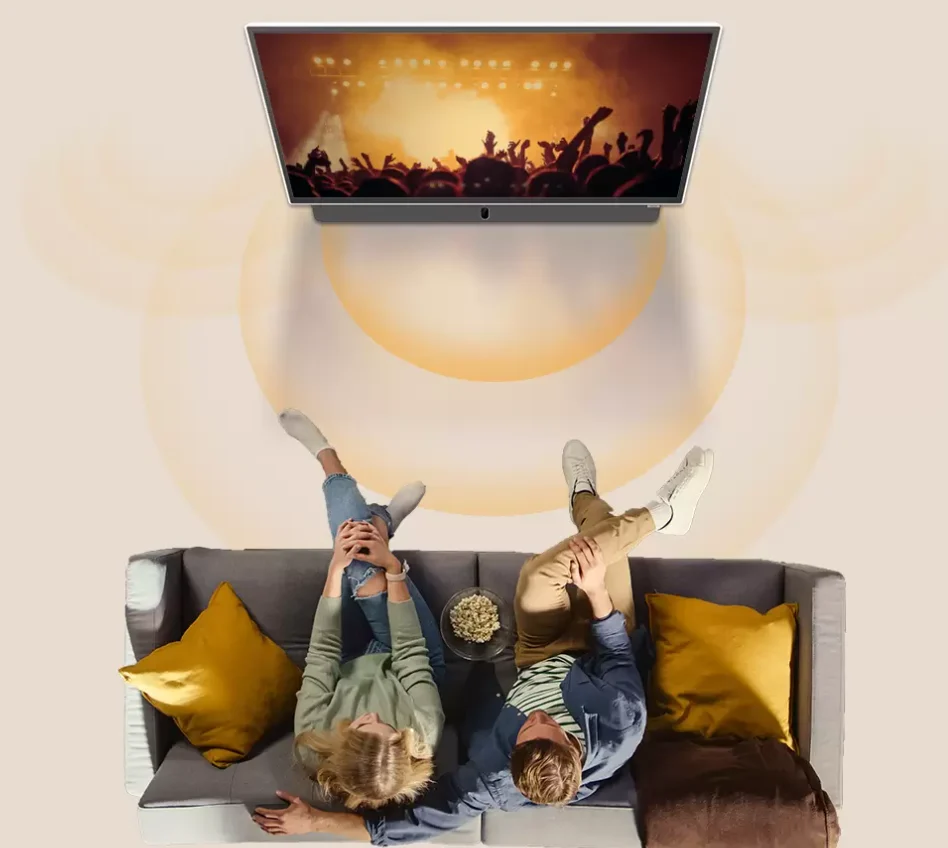
A hypothetical room comparison links the exact cabinet and support dimensions to a nominal image and two labelled seat positions. Image geometry and furniture differences are separate from required clearances, support approval and off-axis picture performance.
5. Turn the numbers into an evening trial
Mark the nominal image outline at a proposed height and sit normally in each seat. Check subtitle-to-face eye movement, the relationship to shelves and the soundbar, and whether someone walking through interrupts the arrangement. Moving the main seat closer is another experiment: the same nominal image spans about 29.8 degrees at 270 cm rather than 27.0 degrees at 300 cm.
Sony's general television guidance distinguishes a screen-height reference minimum from mixed-viewing and cinematic angle examples, with room and personal adjustment. For this nominal image, original calculations give about 269 cm for 30 degrees and 198 cm for 40 degrees. These are trial choices, not medical thresholds or a uniquely correct distance. [S3]
For performance decisions, request the exact model with familiar content. Include a subtitled programme, an ordinary broadcast and the interface of your planned player. Check daytime and evening lighting. Record observations from both seats instead of treating an impressive demonstration as proof of every source or off-axis viewing condition.
6. Map everyday devices without making picture promises
The supplied model documents list QD-MiniLED, 3840 x 2160 resolution, Google TV, WLAN/LAN, three HDMI inputs with CEC and ARC on HDMI 1, and two USB ports. These establish a practical connection worksheet for this exact model, not comparative picture quality. Reserve HDMI 1 if a compatible ARC audio route needs it, then assign the remaining sources. [S1]
Check the intended Italian apps and subscriptions separately; an operating-system name cannot promise every service or future entitlement. Include suitable furniture, agreed delivery, mounting work if relevant and necessary cables in the total cost. Ask the seller to state the full model code and what setup work is included before comparing quotations.
7. Keep the source boundary in one place
Exact installation and configuration figures above come from supplied model documents and their checked mapping; they are manufacturer statements rather than independent test results. [S1] The Italian METZ-branded series page separately displays 55, 60 and 65-inch choices. A displayed size is not address-level stock allocation, retailer authorisation or an installation appointment. [S2]
Before ordering, retain the matching instructions, your measured support and seat positions, the seller's written delivery scope and any mounting assessment. If the screen plane, furniture or bracket changes, revisit the worksheet. The hypothetical case explains which decisions connect; your own measurements determine whether the arrangement is ready.
Frequently asked questions
How wide is METZ 65MNH7000Z?
The documented cabinet width is 144.5 cm with or without base; its base envelope is 131.5 x 29.9 cm. Use cabinet width for overall fit and the base arrangement for full-support checks. [S1]
Does the 160 x 40 cm example guarantee safe support?
No. It leaves numerical differences around the cabinet and base, but furniture construction, stability, full support, clearances and cable access still need checking. The example is not a surveyed or approved installation.
Is the side seat also three metres away?
It is 300 cm perpendicular to the screen plane, but 316.2 cm from the screen centre when offset by 100 cm. Its calculated image span is about 24.5 degrees. These describe assumed geometry, not off-axis picture performance.
Can I reuse an existing wall bracket?
Check the 400 x 200 mm pattern, 13.9 kg without-base configuration, bracket and screw instructions, wall structure, fixings and cable access. Matching holes alone cannot approve the complete installation. [S1]
Sources and scope
S1 · Supplied METZ datasheets and checked installation mapping (supplied documentation; no public web link)
Access recorded: 2026-10-16
Supports: Exact 65MNH7000Z physical and existing configuration facts
Scope: Local: content/preflight/metz-supplied-material-recheck-20261012.json and metz-installation-preview-implementation-20261012.json; Manufacturer-stated; preview scope, not independent testing or installation approval
Supports: General distance framework and personal adjustment
Scope: Previously fetched in evidence record, not refetched in this revision; Not METZ evidence or medical advice; article geometry is original calculation
This website uses cookies to provide you with a safer and more personal experience. By accepting, you agree to the Cookie Policy and the use of cookies for advertising and analytics purposes.